
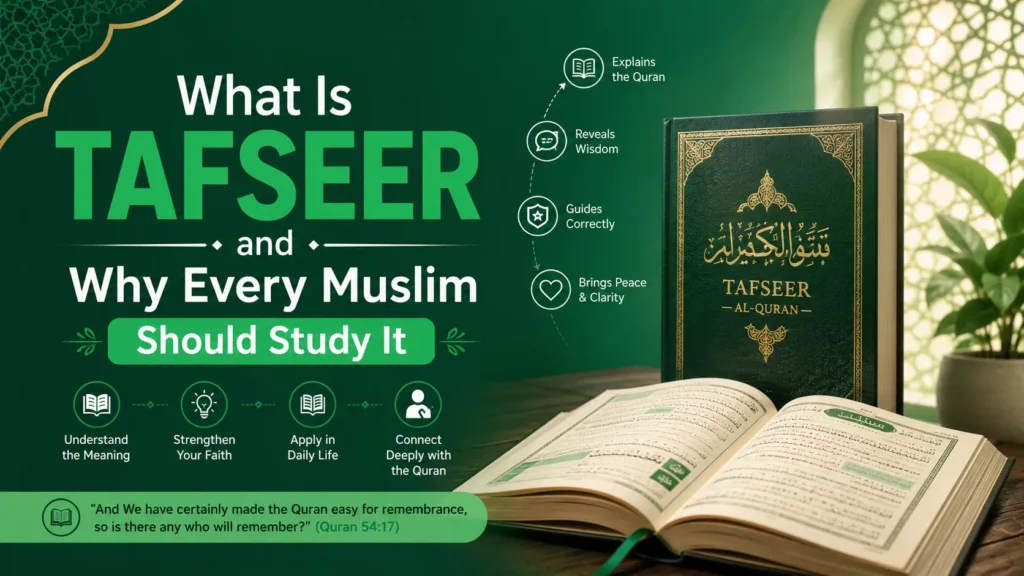
A question we hear often from parents, and just as often from adults revisiting their faith later in life, is some version of this: “I can read the Quran, sometimes I’ve even memorized parts of it, so why do I need to study Tafseer too?” It’s a fair question, and the honest answer is that reading and memorization give you the words. Tafseer is what helps you understand what those words actually mean, in context, and how they apply to real life.
This distinction matters more than it might seem at first. Here is what Tafseer actually is, why it is treated as its own field of study rather than something that happens automatically through reading, and how to approach learning it without feeling overwhelmed.
What Tafseer Actually Means
Tafseer refers to the scholarly explanation and interpretation of the Quran. It goes beyond a word-for-word translation to explain the context a verse was revealed in, how one verse relates to others, relevant Hadith that clarify its meaning, and how classical scholars have understood it over centuries. Tafseer is a structured discipline with its own methodology, built on the Quran itself, authentic Hadith, the understanding of the Prophet’s companions, and the Arabic language.
This is different from simply reading a translation. A translation gives you one scholar’s rendering of the words into another language. Tafseer explains the reasoning, background, and layered meaning behind those words, which a translation alone often cannot capture.
Tafseer vs Translation: Where the Line Actually Is
It is easy to assume that reading a Quran translation is the same as studying Tafseer, but they serve different purposes. A translation typically gives you the closest possible meaning of the Arabic text in another language, in a single, linear reading. Tafseer, on the other hand, might spend several pages explaining the historical circumstances behind a single verse, the different scholarly opinions on a particular phrase, and how that verse connects to guidance found elsewhere in the Quran or in the Sunnah.
For example, a translation of a verse about patience might simply render the meaning of the words. A Tafseer of the same verse might explain the specific situation the Prophet’s companions were facing when it was revealed, why patience was emphasized in that moment, and how scholars have applied that guidance to different circumstances since.
If you are looking to start with translation before moving into deeper Tafseer study, that progression is a natural and common starting point, and it is exactly How Our Quran Translation & Tafseer course is structured, beginning with clear meaning before layering in scholarly context.
Why Understanding Matters as Much as Reading
The Quran describes itself as a book of guidance, not simply a text to be recited. Reciting with correct Tajweed is a form of worship in itself, but understanding what is being recited is what allows a person to actually apply that guidance in daily decisions, relationships, and worship.
Many Muslims recite the Quran regularly for years without ever exploring what specific verses mean in depth, not out of disinterest, but because Tafseer study is often treated as a separate, later stage rather than something introduced early. This is a gap worth closing intentionally, rather than assuming understanding will simply happen on its own over time.
What Tafseer Study Actually Covers
A structured Tafseer course typically works through several layers for each verse or passage:
- Context of revelation (Asbab al-Nuzul): The circumstances or events that led to a particular verse being revealed, which often clarifies its intended meaning.
- Linguistic meaning: How specific Arabic words and phrases were understood at the time, since word meanings and connotations can shift over centuries.
- Cross-references within the Quran: How a verse relates to or is clarified by other verses on the same topic elsewhere in the Quran.
- Supporting Hadith: Authentic sayings or actions of the Prophet Muhammad (peace be upon him) that explain or expand on a verse’s meaning.
- Scholarly interpretation: How recognized, qualified scholars across different eras have understood and explained the verse, since Tafseer is built on a continuous scholarly tradition rather than individual opinion.
This is why Tafseer study benefits strongly from a knowledgeable teacher rather than independent reading alone, particularly in the early stages. Verses can be easily misunderstood when read in isolation, without the surrounding context that trained scholarship provides.
Common Concerns Parents and New Students Have
Is Tafseer only for advanced students?
Not necessarily. Basic Tafseer, especially of shorter, frequently recited surahs, can be introduced at a level appropriate for children and beginners. What matters is starting with clear, age-appropriate explanations rather than skipping the subject entirely until later.
Can I study Tafseer without knowing Arabic?
Yes. Tafseer study can be conducted through translation and explanation in your own language, with a teacher who bridges the Arabic meaning where it matters most. Learning Arabic alongside Tafseer deepens the study over time, but it is not a prerequisite to begin.
Is it safe to rely on Tafseer content found online without a teacher?
This is worth being cautious about. Tafseer requires grounding in recognized scholarship, and not everything available online meets that standard. A qualified teacher can guide you toward reliable sources and help you understand context that a video or article alone might present without explanation. If you’re building broader religious knowledge alongside Tafseer, Our Islamic Studies course covers Aqeedah, Fiqh, and Hadith in a structured way that complements Tafseer study.
How to Begin Studying Tafseer as a Beginner
Starting Tafseer study does not require working through the entire Quran from the first page. A more practical approach is to begin with:
- Short, frequently recited surahs, such as Al-Fatiha or the final short surahs, since their meaning is manageable and immediately applicable to daily prayer.
- A structured course with a qualified teacher, rather than piecing together explanations from multiple unfamiliar sources.
- One verse or short passage at a time, spending real time understanding it rather than moving quickly to cover more ground.
- Reflection alongside study (Tadabbur), taking a moment after each session to consider how the meaning connects to your own life, not just academically noting it.
Why a Teacher Matters for This Subject Specifically
Tafseer is a field where context changes meaning significantly. A verse read without its surrounding explanation can be misunderstood in ways that a knowledgeable teacher would immediately clarify. This is different from, say, practicing Tajweed, where the main risk of self-study is mispronunciation. With Tafseer, the risk of misunderstanding meaning without guidance is a more significant concern, which is why structured, teacher-led study is strongly recommended over independent reading alone, especially at the beginning.
Our Quran Translation & Tafseer course is taught by teachers trained specifically in this area, working through meaning and context at a pace suited to the student, whether that is a teenager building early understanding or an adult who already reads Quran fluently and wants to go deeper into its message.
Frequently Asked Questions
What is the difference between Tafseer and Tafsir?
They refer to the same thing. Tafsir and Tafseer are simply two common English spellings of the same Arabic term for Quranic exegesis.
At what age can a child start learning basic Tafseer?
Simple, age-appropriate explanations of short surahs can often begin around age seven or eight, alongside their regular Quran reading, with more detailed study introduced as they grow older.
Do I need to know Arabic before studying Tafseer?
No. Tafseer can be studied through translation with a teacher explaining meaning and context, though learning Arabic over time can deepen your understanding further.
Which Tafseer is recommended for beginners?
Classical, widely recognized Tafseer works are generally recommended over lesser-known or unverified sources, and a qualified teacher can guide you toward reliable options suited to your level.
Is studying Tafseer more important than memorizing the Quran?
They serve different purposes and are not really in competition. Memorization preserves the text, while Tafseer builds understanding of its meaning. Many students pursue both, often studying Tafseer of the portions they have already memorized.
Understanding the Quran’s meaning turns recitation into something you can actually apply in daily life, not just recite from memory. If you would like guided, structured Tafseer study with a qualified teacher, You can book a free trial class and see how our approach works before committing to a course.