
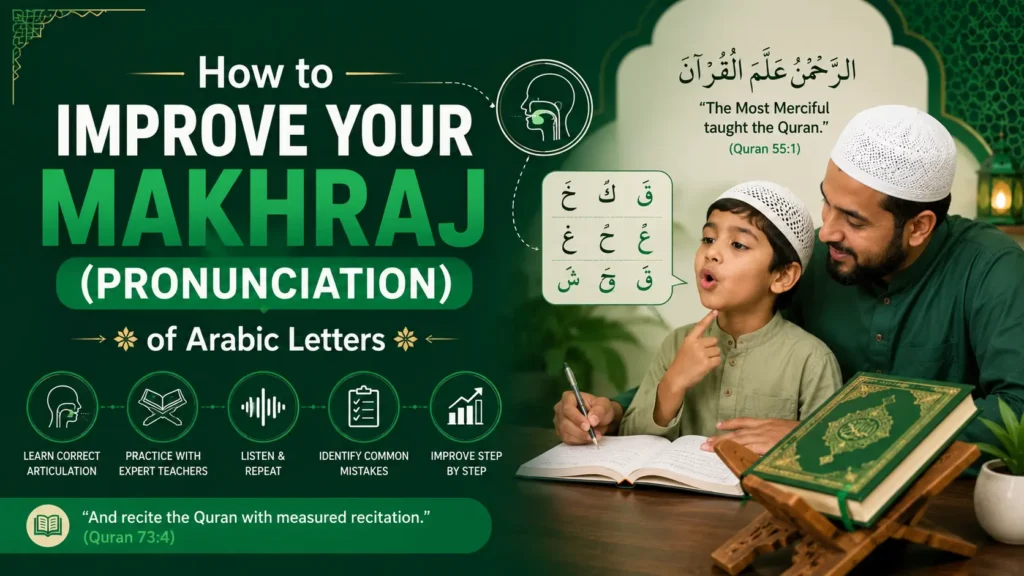
Makhraj is one of those words that sounds technical until you actually sit with a teacher and hear the difference it makes. It simply means the exact point in the mouth or throat where a letter’s sound originates. Get the Makhraj right, and a letter sounds the way it should. Get it slightly wrong, and you might accidentally change the meaning of a word, or simply sound unclear when reciting.
We hear this question often from students who have been reading Quran for years but were never corrected properly at the start: “Why does my teacher keep stopping me on the same letters?” Usually, the answer is a Makhraj issue that was never fixed early on. It is fixable at any age, but it takes focused, repeated practice, not just reading more. Here is how we approach it with our own students.
What Makhraj Actually Means
Arabic has 17 main points of articulation, called Makharij al-Huroof, spread across five general areas: the throat, the tongue, the lips, the nasal cavity, and the empty space in the mouth and throat used for certain long vowel sounds. Each of the 29 letters comes from one of these points, and several letters share a general area but differ in the exact spot or the shape the tongue or lips make.
This is why some letters that look completely different on paper, like “ز” (zaa) and “ظ” (zaa with a dot, from a different point), can end up sounding almost the same if a student was never taught the precise difference. The letters are distinct. The confusion is in the training, not the language itself.
If you are still building your foundation with the alphabet itself, it is worth starting there first. Our guide on How to teach the Arabic alphabet to beginners step by step covers the stage that comes before Makhraj refinement.
Why Makhraj Matters Beyond “Sounding Correct”
Some letter pairs in Arabic change the actual meaning of a word depending on which one is used. A well-known example is the difference between “قلب” (qalb, meaning heart) and a mispronounced version using the wrong throat letter, which changes the word entirely. This is one reason Tajweed and Makhraj are not treated as optional polish in Quran recitation. They protect the meaning of what is being recited. This is also why we place such heavy emphasis on Makhraj correction in Our Quran Reading with Tajweed course. Reading quickly is not the goal in the early stages. Reading correctly is.
The Five Points of Articulation, in Plain Terms
You do not need to memorize the technical Arabic terms to understand the idea. Here is a simplified breakdown:
- The throat (Al-Halq): Produces letters like ء، ه، ع، ح، غ، خ. These are usually the hardest for Bangla and English speakers, since none of these exact sounds exist in either language.
- The tongue (Al-Lisan): The largest group, covering most letters, including ق، ك، ج، ش، ي، ض، ل، ن، ر، ط، د، ت، ص، س، ز، ظ، ذ، ث. The tongue’s position against the teeth, palate, or roof of the mouth changes the sound.
- The lips (Ash-Shafatan): Covers ف، و، ب، م.
- The nasal cavity (Al-Khaishoom): Responsible for the nasal sound (ghunnah) that occurs with noon and meem in certain Tajweed rules.
- The empty space (Al-Jawf): Produces the long vowel sounds, alif, waw, and yaa when extended.
Knowing which group a letter belongs to helps a student understand why they are struggling with it, which is often more useful than being told to “just say it again.”
Step-by-Step Ways to Improve Your Makhraj
1. Isolate the Letters You Struggle With
Do not try to fix every letter at once. Ask your teacher, or listen carefully yourself, to identify the two or three letters you consistently mix up. For most Bangla-speaking learners, the throat letters (ح, ع, خ, غ) and the emphatic letters (ص, ض, ط, ظ) are the most common trouble spots.
2. Practice in Front of a Mirror
This sounds simple, but it works. Watching your own mouth and tongue position while pronouncing a difficult letter helps you notice habits you cannot feel on your own, like using the wrong part of the tongue or not opening the throat enough for letters like ح.
3. Slow Down Before You Speed Up
Fluency is not the first goal when correcting Makhraj. Say the letter slowly and deliberately, focusing entirely on the point of articulation, before trying to read it at normal recitation speed. Many students revert to old habits the moment they try to read quickly, so slow, deliberate repetition needs to come first.
4. Use Minimal Pairs
Practice letters that are commonly confused, side by side, in the same session. For example, alternate between س (seen) and ص (saad), or ت (taa) and ط (Taa), several times in a row. Hearing and producing the contrast repeatedly trains your ear and mouth together.
5. Record Yourself
Recording your own recitation and listening back, ideally comparing it to a qualified reciter reading the same letters or verse, can reveal mistakes you do not notice while speaking. This is a habit many advanced reciters still use.
6. Get Corrected in Real Time, Not After the Fact
This is the step most self-study routines miss entirely. A recorded lesson or an app can tell you what a letter should sound like, but it cannot listen to you and tell you, in that exact moment, that your tongue is in the wrong position. A live teacher, listening closely during recitation, catches these errors while they are still easy to correct. This is the core reason Makhraj improvement is difficult to achieve through self-study alone, no matter how motivated the student is.
Common Mistakes Students Make While Trying to Fix Makhraj
- Trying to fix too many letters at once, which usually means none of them improve.
- Practicing only during class, without daily repetition at home.
- Ignoring feedback because progress feels slow. Makhraj correction, especially for adults who have read incorrectly for years, takes weeks of consistent practice, not a single session.
- Confusing loudness with correctness. Saying a letter louder does not fix the point of articulation; it only makes the existing mistake more noticeable.
- Skipping revision of previously corrected letters. Old habits can quietly return if a corrected letter is not revisited regularly.
Can Adults Fix Makhraj Mistakes They Have Had for Years?
Yes, though it takes more patience than correcting a child who has not yet formed the habit. Adult learners often need a period of conscious, slow practice before the correct pronunciation starts to feel natural instead of forced. We have worked with adult students who spent decades reading with the same mispronounced letters and were able to correct them within a few months of consistent, teacher-guided practice. It is a matter of consistency, not age.
How a Teacher Makes This Faster
Self-correction has a ceiling. You can only hear your own mistakes so well, especially with sounds your native language does not use. A qualified teacher listens to your recitation directly, identifies the exact letter and moment the error happens, and gives you a specific correction rather than general advice. This is the same approach we use in our Quran Reading with Tajweed course, where each session includes direct listening and correction rather than group reading without individual feedback. If you are earlier in your journey and still building comfort with the alphabet itself before working on precise Makhraj, Our Noorani Qaida course is the right starting point.
Frequently Asked Questions
What is the difference between Makhraj and Tajweed?
Makhraj refers specifically to the correct point of articulation for each letter. Tajweed is the broader set of rules for reciting the Quran correctly, which includes Makhraj along with rules for elongation, nasalization, stopping, and more. Correct Makhraj is a foundation that Tajweed rules are built on top of.
Which Arabic letters are hardest to pronounce for Bangla speakers?
Most Bangla-speaking learners find the throat letters, ح، ع، خ، غ، ق, and the emphatic letters ص، ض، ط، ظ the most challenging, since these sounds do not have close equivalents in Bangla.
How long does it take to correct Makhraj mistakes?
It varies by student and by how many letters need correction, but with regular practice, three to five times a week, most students notice clear improvement within four to eight weeks for a small number of letters. Long-standing habits in adults may take longer.
Can I improve Makhraj by watching YouTube videos alone?
Videos can help you understand where a sound is supposed to come from, but they cannot listen to your recitation and correct you in real time. Most students who rely only on videos plateau at a certain point because there is no feedback loop.
Do I need to fix my Makhraj before starting Hifz?
It is strongly recommended. Memorizing the Quran with incorrect pronunciation means the mistakes get memorized along with the verses, which is far harder to correct later than fixing pronunciation before memorization begins.
Correct Makhraj is not about sounding impressive. It is about reciting the Quran the way it was meant to be read, with the meaning intact. If you would like a teacher to listen to your recitation and identify exactly which letters need work, You can book a free trial class and get a clear starting point before committing to a full course.