
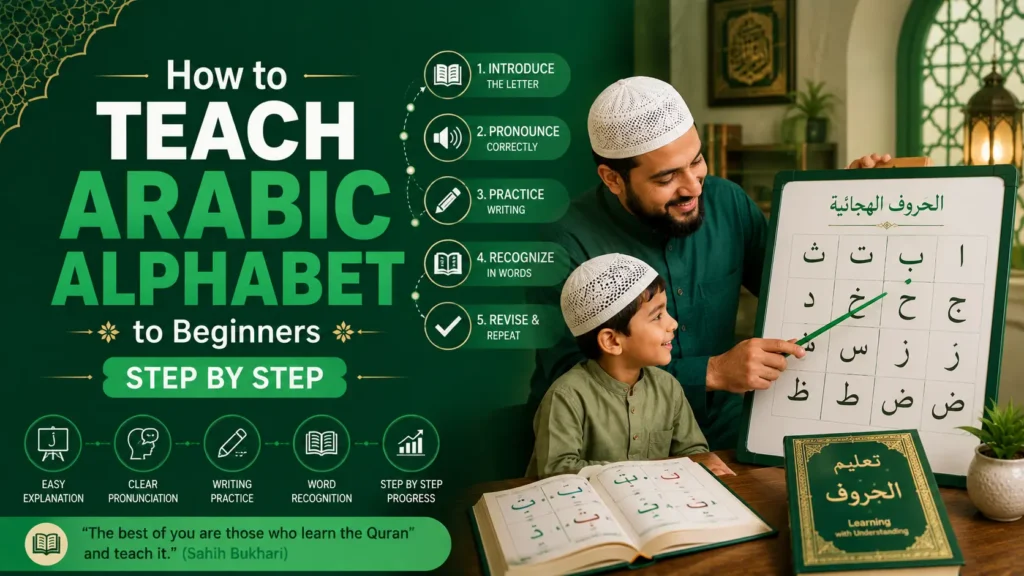
Every Quran learning journey starts in the same place: twenty-nine letters. Before a child or an adult can read a single verse with confidence, they need to know these letters by sight, by sound, and by the way they change shape depending on where they sit in a word. This step is called the foundation stage, and in our experience teaching students across Bangladesh and abroad, it is the stage most families rush through, and the one that causes the most trouble later.
We have worked with hundreds of Noorani Qaida students, from four-year-olds who cannot sit still for five minutes to adults learning Arabic for the first time in their fifties. The letters do not change. What changes is how patiently you teach them. Below is the step-by-step process we use with our own students, along with the mistakes we see most often from parents trying to teach at home.
Why the Arabic Alphabet Deserves Its Own Stage
Arabic is not read the way Bangla or English is read. Letters shift shape at the beginning, middle, and end of a word. Some letters look almost identical and are only told apart by a dot above or below. A few sounds, like the difference between “س” (seen) and “ص” (saad), do not exist in Bangla or English at all, so the mouth has to learn a new movement, not just a new symbol.
This is exactly why the Noorani Qaida stage exists before a student ever opens a Quran. Skipping ahead to Quran reading before the alphabet is solid usually shows up later as slow reading, mixed-up letters, or pronunciation habits that are hard to correct once they set in. If you want to understand how this stage fits into the full learning path, Our Guide on How long it takes to complete Noorani Qaida walks through a realistic timeline.
Step 1: Start With Recognition, Not Writing
Before a student writes a single letter, they should be able to point at it and name it. Show one letter at a time, in its standalone form, and repeat the name out loud several times. For young children, flashcards work well because they remove distractions. For adults, a simple printed alphabet chart is enough.
Do not move to a new letter until the current one is recognized instantly, without pausing to think. This might feel slow in the first week. It saves months of confusion later.
Step 2: Teach the Sound Before the Shape
A common mistake is teaching students to say the letter’s name in isolation, such as “alif,” “ba,” “ta,” without connecting it to the actual sound the letter makes in a word. A student who only memorizes names but never practices the sound will struggle the moment they try to read.
For each letter, say the sound clearly and have the student repeat it back at least five to ten times. Watch the mouth, not just the sound. Some letters, like “ح” and “ه”, sound close to each other to an untrained ear but come from different points in the throat. This is where having a live teacher matters far more than an app or a video, because a real teacher can hear the mistake and correct it on the spot. This is one reason Our Noorani Qaida course is taught one-on-one rather than through pre-recorded lessons.
Step 3: Introduce Letter Shapes in Context
Once a student recognizes a letter and its sound on its own, show them how it looks at the beginning, middle, and end of a word, and when it stands alone. This is usually the hardest part for beginners, because a letter like “ع” can look almost unrecognizable depending on its position.
A simple way to practice this is to pick one letter per session and find three or four words where it appears in different positions. Ask the student to point out the letter each time. This builds pattern recognition instead of memorization, which is what actually makes reading fluent later.
Step 4: Add Harakat (Vowel Signs) Gradually
Once a student is comfortable with the letters themselves, introduce the basic vowel marks: fatha, kasra, and damma. Go one at a time. Combine it only with letters the student already knows well, so they are practicing one new skill at a time rather than three. A frequent error we see in home teaching is introducing all three vowel signs in the same week the alphabet is introduced. This overwhelms most learners, especially younger children. Slower and steady almost always beats fast and shaky.
Step 5: Practice Joined Letters and Simple Words
After single letters and vowel signs feel natural, move to joining two or three letters into simple words. This is where a student starts to feel like they are actually reading, and it is a strong motivation boost, especially for children. Keep the words short at first. Read them slowly, sound by sound, before blending them together. Rushing this step is another common reason students develop the habit of guessing words instead of sounding them out properly, a habit that is genuinely difficult to unlearn later.
Step 6: Repeat, Revise and Never Skip Review
Arabic alphabet learning is not something a student finishes once and moves past. Each new session should start with a short review of everything learned so far, even if it feels repetitive. Repetition is what moves a letter from short-term memory into something the student can recall instantly, without thinking. We build this review time into every Noorani Qaida class for exactly this reason. A teacher who tracks each student’s weak letters and brings them back into practice regularly will get better results than one who only moves forward.
Common Mistakes Parents Make When Teaching at Home
- Moving too fast. Wanting to see quick progress often leads to skipping the recognition and sound stages.
- Ignoring pronunciation errors. A mispronounced letter feels small at first but becomes a habit that is hard to correct after a few months.
- Teaching writing before reading is solid. Writing is valuable, but it should support reading, not replace practice time that should go toward recitation.
- Inconsistent practice. Ten minutes every day builds more progress than an hour once a week.
- No one to correct mistakes in real time. This is the biggest gap in self-study. A student can practice a letter incorrectly for weeks without realizing it, simply because there is no one listening closely enough to catch it.
If you have already noticed some of these patterns with your own child, Our Article on How to improve Quran reading skills as a beginner covers how to correct habits that have already set in.
Is It Too Late to Start as an Adult?
No. We regularly teach adults who never learned to read Arabic as children and are starting from the very first letter. The process is the same, though adults usually move through recognition and sound stages faster since they can self-correct and study independently between sessions. What matters most, at any age, is consistency and a teacher who checks pronunciation closely rather than letting small errors pass.
For adults who want to go beyond the alphabet stage and build real fluency in reading, writing, and speaking Arabic, our Arabic Language course is a natural next step after the alphabet foundation is solid.
How Long Should This Stage Take?
There is no single answer, since it depends on the student’s age, how often they practice, and whether they are learning one-on-one or in a group. As a general guide, most beginners with regular practice, three to five sessions a week, recognize and sound out all twenty-nine letters within four to eight weeks. Joining letters into simple words usually follows within another month or two. Children under six, or students practicing only once a week, often need longer, and that is completely normal.
Frequently Asked Questions
What age should a child start learning the Arabic alphabet?
Most children can begin around age four or five, once they can sit and focus for short periods. Some start earlier with simple letter recognition games, but structured lessons usually work better from age four onward.
Should I teach Arabic alphabet order or teach letters out of order?
Following the traditional Noorani Qaida order is recommended, since the sequence is designed to build sounds progressively, from simpler pronunciation to more difficult ones.
Can I teach my child the Arabic alphabet myself without a teacher?
You can introduce basic recognition at home, but correcting pronunciation is difficult without training, since several Arabic sounds do not exist in Bangla or English. Most families find it more effective to combine home practice with a qualified teacher who can catch and correct mistakes early.
How many letters should be taught in one session?
For young beginners, one or two new letters per session is usually enough, with the rest of the time spent reviewing previous letters. Adults can often manage two or three new letters per session.
Do online classes work for teaching the Arabic alphabet to young children?
Yes, when the class is one-on-one and the teacher is trained to work with children. A screen does not change the fundamentals of teaching letters and sounds; what matters is the teacher’s attention and consistent correction, which is possible in a well-run online class just as it is in person.
Learning the Arabic alphabet properly is the single most important investment a beginner can make before starting Quran reading. It takes patience, and it is worth doing slowly. If you would like a qualified teacher to guide your child, or yourself, through this stage with proper pronunciation and steady progress tracking, you can book a free trial class with our Noorani Qaida teachers and see how the first lesson goes before committing to anything.